Rajesh Panicker

Life Coach, Life skill trainer, CEO of YUP Training Solutions and SRK Trainers . Wellness Coach (Founder of YogaUpasana) . Yoga Therapist (Yogic science) , Certified NLP Trainer , Certified Counsellor.Laughter Therapist , Hypnotist Certified from Jacquin Hypnosis Acadamy, UK .

Rajesh Panicker

Wellness Coach (Founder of YogaUpasana) .

YUP Training Solutions

Yoga Therapist (Yogic science) , Certified NLP Trainer , Certified Counsellor.

Rajesh Panicker

Laughter Therapist , Hypnotist Certified from Jacquin Hypnosis Acadamy, UK

Rajesh Panicker

Worked as Yoga Coach at SCMS Kochi, Worked in pharmaceutical industry for more than 20 years (since 1997).

Total Pageviews

Saturday, October 23, 2021

à´šà´ª്à´ªാà´¤്à´¤ിà´•്à´•െà´¨്à´¤ാ à´•à´±ി ...?(Chappatthikkenthaa curry...?) -- Communication Problem


Watch this !!!
A man feared his wife wasn’t hearing as well as she used to and he thought she might need a hearing aid. Not quite sure how to approach her, he called the family Doctor to discuss the problem. The Doctor told him there is a simple informal test the husband could perform to give the Doctor a better idea about her hearing loss...


Idea & Script: Rajesh Panicker

Camera: Mayan Vaidar Shah

Editing: Gurukripa Aluva

Direction: Viswam Panambukad

Acted & created by 16th Batch Students of Santhwana Institute Of Counselling And Psychotherapy under the guidance of Fr. Dr. Varghese Pudussery CMI, Ph.D.


Tone Setting/Adaptability & Life Management Sessions at RATTC Vyttila ( October 2021)

 Batch: Agricultural Assistants

@ RATTC (Regional Agricultural Technology Training Centre) Vyttila

Venue : On-line (Zoom)

Topic : Day 1 :- Tone Setting & Adaptability

Topic : Day 2 :-  Life Management : Manage yourself to Manage stress.

Date : OCT 2021.


Thursday, October 7, 2021

Office Etiquette & Life Management Sessions at RATTC Vyttila ( October 2021)

Batch: Agricultural Officers 

@ RATTC (Regional Agricultural Technology Training Centre) Vyttila

Venue : On-line (Google Meet)

Topic : Day 1 :- Office Etiquette

Topic : Day 2 :-  Life Management : Manage yourself to Manage stress.

Date : OCT 2021.


Wednesday, September 15, 2021

Curriculum Vitae – How to prepare your CV?

How to prepare your CV?

C V Opens Doors for Employment. So, effective CV Writing is vary important
            Length: As long as it takes
            Content: Area-specific listing of education and academic background, skills and interests
Curriculum Vitae (or CV) (Latin origin) Means “the course of one’s life”
 
What is the purpose of a CV?
        • To inform the employer about your education, work experience, skills and interests
        • To ‘sell’ these qualities and to persuade the employer to invite you to interview
It’s all about you CVs are an opportunity to show an employer why you are an ideal candidate for the job. A good CV will:
          •Stand out from the crowd.
          • Draw attention to your relevant skills, experience, achievements and potential.
          • Create such an impression on the employer that they will not be able to turn you down for interview.

Everyone has potential. Everyone has more skills than they think they do. Everyone can write a good CV
 
Dos:-
        • Use a standard font size in.
        • Include recent and relevant work experience (paid or voluntary).
        • Be consistent in your layout.
        • List your skills and achievements and back up with evidence.
        • Keep it short (maximum 2 pages).
        • Use positive action verbs such as “organized, delivered, accomplished, achieved”.
        • Include a statement about your career aspirations and what you have to offer the employer.
        • Be honest but positive (negatives can always be turned into positives).
        • Proof-read for spelling, punctuation, grammar and meaning.
        • Get someone to check it for you.
Don’ts:-
        • Do it in a rush.
        • Leave gaps in employment.
        • Lie.
        • Include irrelevant personal details such as marital status.
        • Simply write a list of duties under work experience (remember you are selling yourself!).
        • Use flashy or large font.

There is no single way to write a CV. It is your document and can be structured and presented as you wish within a basic framework. The important thing to remember is that this is the first impression an employer will have of you. It is your marketing brochure through which you are trying to sell yourself. 5 Tips for a better CV preparation: -

    • Clear – well organized and logical

    • Concise – relevant and necessary

    • Complete – includes everything you need

    • Consistent – don’t mix styles or fonts

    • Current – Up-to-date


What should be on a CV?
    • Start with contact information
        – Full name
        – Permanent mailing address
        – E-mail address that won’t expire
        – Phone numbers

    • Education

    • Honors and Awards

    • Professional Experience (employment)

    • Publications and presentations

    • Extracurricular and volunteer experience
Other sections for a CV
    • Certifications and licensure
    • Professional affiliations
    • Professional activities
    • Research
    • Added qualifications
 
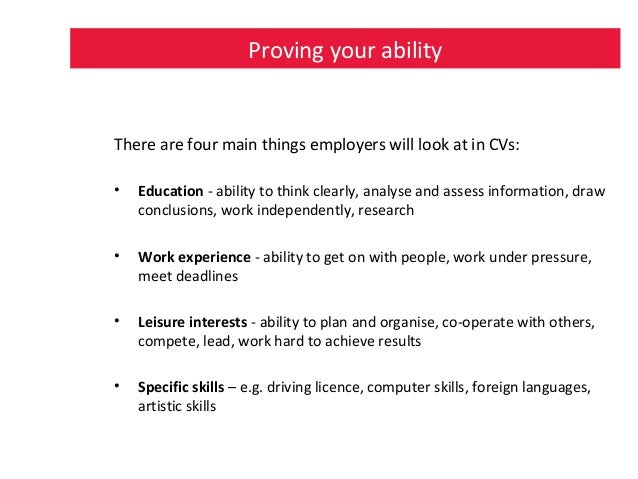
Proving your ability, there are four main things employers will look at in CVs:
    • Education - ability to think clearly, analyze and assess information, draw conclusions, work independently, research
    • Work experience - ability to get on with people, work under pressure, meet deadlines
    • Leisure interests - ability to plan and organize, co-operate with others, compete, lead, work hard to achieve results
    • Specific skills – e.g., driving license, computer skills, foreign languages, artistic skills
 
Tips on Education section
    • Most current schooling first (include your current educational work)
    • Only include diploma distinctions
    • Get the school’s names correct!
    • Degrees/certifications are what is important – not time spent
    • List Thesis/Dissertation titles
 
Tips on Honors and Awards Section
    • List most recent first
    • Honors/Award Title – then date received
    • Go back to undergrad but not before. – Only academic or professional
    • Scholarship count
 
Tips on Professional Experience Section
    • Includes anything you were paid to do or was extensive and regular volunteer work
    • Only list items relevant to academic work
    • List most recent first
    • If listing research, include the lab and director/principle investigator
 
Work Experience
    • There is no need to list every job you’ve ever had – detail the most relevant
    • Don’t just list your duties – sell your skills. Which skills are relevant to the position/company you are applying to?
    • Dates, name of company, position and skills
 
Tips on Extracurricular and Volunteer Experience Section
    • List most recent first
    • This tends to be a long list – careful!
    • It is better to have long-term items or very relevant items instead of EVERYTHING
    • Student organizations go here
 
Tips for Professional Section Affiliations
    •Only those current
    •Most current first
    •Include all dates of affiliation
    •Note any leadership positions Activities
    •Past and present
    •Most current first
    •Only those specific to academic/research
    •Should be school or university sponsored
    •Include your role
 
Tips for Research Section
    • List most current first
    • Make sure you indicate others you worked with
    • Include grant funds if obtained
    • Briefly describe here
 
Publications and Presentations Section
    • Two options for listing – Most recent – Order of publication
    • Always bold your name in authorship
    • Include submitted and/or pending publications or presentations
    • Presentations may be large or small but pertinent enough to talk about
    • Have copies of your pubs and/or presentation for the life of your CV
 
Added Qualifications Section
    •Should be verifiable
    •Include language fluency
    •Cultural knowledge – maybe. Especially if you have had hands-on experience 
    •Anything else special
 
What examples can you give from your work experience? If you have no paid work experience, give examples from voluntary work or from your course matching up your CV with the position/company
It is not ‘one size fits all’, you need to tailor your CV to each position you apply for. Research the company. Do they have a mission statement or core values? What will they be looking for in you? Who works there at the moment? What are they passionate about?
 
Presentation of your CV
 
    • The first visual impression of your CV is important
    • For standard CVs, use plain white A4 paper
    • Do not double side
    • Keep your CV to two sides of paper
    • Check your spelling
    • Use bullet points and bold font but in moderation
    • Formatting – make sure it’s consistent
    • Size 10-12 font (depending on font style)
    • Clear font e.g. Arial, Calibri
    • Focus on accomplishments
    • Target your CV to that job/company
    • 2:1, not Two One or 2,1
    • Use short, concise sentences
    • Consider your audience
 
References
    • Ideally, one academic and your manager
    • Ask permission from your reference and let them know what position(s) you’ve applied for
    • Use relevant references if possible
    • You can say ‘references available on request’ rather than including contact details if you wish
 
Covering letters
    • Never send a ‘naked’ CV
    • There are two types of covering letters: • Speculative/accompanying letter or Letter of application
Speculative/Accompanying letter
    • Should be three short paragraphs
    • Opening paragraph – why you are writing
    • Paragraph 2 – show knowledge of employer, highlight your skills
    • Paragraph 3 – Refer to your CV and availability
Letter of application
    • Used when asked to ‘apply in writing’ or ‘send CV and cover letter’
    • 1 side of A4 – similar to a personal statement
    • Followed by background skills and experience developed through study, work experience and paid work
    • ‘Matching up’ with job description
    • What you can offer the employer
 
Where to find jobs

Networking
    • Use your contacts from your work experience/course/friends
    • Use social networking sites such as LinkedIn, upload a portfolio of your work onto it
    • Attend events, keep business cards and keep in contact

Internet sources

Alternative Routes

  •     Postgraduate Study
  •     Masters/PhD
  •     Self-employment/Freelance

Professional Physio SEP 2021


If you aspire to become a professional physiotherapist you must strive hard for it. Choice of course, college and career are your decision. All you need to remember is your interest area not only in the subject but also in the job profile. If you have successfully acquired the relevant degree, then the rest is left to you to become a professional.

Physiotherapists in India are paid well. The initial pay scale of as compared to other healthcare industry jobs is comparatively more. With the changing health conditions and lifestyle of the people, the requirements of physiotherapists have increased and this increment will continue in the near future. Therefore, the number of employment opportunities are more for the new therapists. It is a job that can be done anywhere and the professionals need not necessarily be associated with an organisation or institution. You have a scope of starting your own practice and can open your clinic on your terms and conditions. As a physiotherapist, you get the chance to interact a number of people of different stream and genre which in a way will help you to gain more knowledge not only of your field but also of different fields.

The job of a physiotherapist demands time and attention. As a physiotherapist, you will have to spend ample amount of time with your patients in order to understand their problems. Time for your personal work will definitely be hampered by this. In order to be a physiotherapist, you too need to be fit and fine with no physical ailments and problems. You will have to work hard on your physique also, which can be troublesome for some. Physiotherapists must most importantly be a good communicator. If you are an introvert or are not comfortable in commuting with people then this job is not meant for you. You need to have a lot of patience with the patients. Sometimes you may lose control but this will affect your professional life. Physiotherapists need to be very attentive while dealing with patients suffering from multiple or sensitive diseases or problems.

Here in this “campus to corporate” program, we are discussing on how to prepare yourself for job hunting, interview, salary negotiation and how you can fine tune yourself as a professional with values and ethics

Program:-

7.00pm
*Prayer 
*Welcome Address 
*Principal Address 
*Inaugural Address by Director
*Address by Resource Person 
* Students View by Class Representative
*Vote of thanks

Saturday, June 5, 2021

Do you want to reduce weight, reduce your stress

Do you want to reduce weight, reduce your stress !!!

Overweight and emotional eating 

It is a myth that overweight of people suffering from uncontrolled stress is only a result of lack of willpower to control their habitual or emotional eating. 

The problem is not lack of will power. We should feel taste, enjoyment and feeling of satisfaction in our brain to stop eating. But when one is stressed, her/his feedback mechanism is not working. And when they actually eat more they are not getting a feeling of eating enough. Or simply we are not fully present to the food and aware of its taste. Brain likely thinks it didn't eat or eat enough. It asks for more and we give in. 

Mood and food 


Our brain is always on. It takes care of every function in our body. It works hard 24/7, even while we sleep. So brain requires constant supply of premium fuel. But that fuel comes from what we eat. So what we eat affects our brain function, our thoughts and ultimately our mood. 

Eating high quality foods that contain lot of vitamins, minerals and antioxidants nourishes the brain and protects it from oxidative stress. But if we ingest more junk food and refined or processed foods, it badly affects the brain and other organ system. 

So please note, modern science too says that there are many consequences and correlations between what we eat, how we feel and how we ultimately behave. 

Foods we eat make us feel good 

Serotonin is a neurotransmitter, which is feel good hormone in our body. It regulate sleep, appetite, mood and inhibits pain. But 95% of this hormone is produced not in the brain but in out gastrointestinal tract! The functions of neurons producing this hormones in the gut is influenced by billions of good bacteria in the intestinal microbiome. So a clean diet is very essential for the growth of these good bacteria and normal functioning of our body. If we follow unhealthy food and food habits that de-promote the growth of these good bacteria and will lead to the growth of bad bacteria and industrial  dysbiosis. It leads to less production of serotonin, more inflammation, less absorption of nutrients and altered industrial wall permeability and absorption of toxins produced by bad bacteria. This ultimately can affect our liver leading to multiple problems.

Here the solution is an optimum nutrition and "satwik" food

If we can "go clean" following a balanced plant diet, we will not believe how much better we can feel both physically and emotionally

Our most important digestive enzyme - "happiness" 

Classic fight or flight response is the only thing you can expect when you experience stress. That's why people report heartburn, gas and digestive upset when they are struck. Digestion is the last thing our body will attend to when  our  engines are in fight or flight mode. That's  the way our body's safety systems have evolved over  millions of years. 

Our digestive system shuts down when stress response system is activated. All our body's energy is focused onto survival from the threat. 

So if we don't eat happily and in a relaxed mood our digestion and assimilation will not happen properly. Ultimately it will result in overeating, symptoms of in digestion, malnutrition and ill health. Happy mindful food habits can convert illness to Wellness. 

Reduce weight, reduce your stress

Stress can make us put on weight. If stress can do that then relaxation should take it off too, right? Yes, this is how it will...

Common reasons of psychological stress responses are fear, anxiety, anger, judgement, negative attitude and negative self talk. When we are stressed we produce more cortisol and insulin which induce the weight storage mechanism of the body by storage of carbohydrates and fats in cells instead of providing energy and building muscles. This also will reduce our calorie burning capacity. No matter how much best weight loss diet in the world we follow, we will get the opposite result. Smile, breath more deeply, we enter the relaxation zone boosting our calorie burning mechanism and reduce our weight. 

If we adopt stressful weight loss strategies- impossible to follow diet plan, overly intensive exercise, tasteless food an extremely low calorie meal plan,  all of these can create stress chemistry that ensures the weight to stay put. 

Clean diet alone will not help us. If we can practice mindful eating being present to the food, enjoying its taste and the nourishment our body is getting, we will stop overeating and our weight will come down.

So relax and lose weight. 


Friday, May 21, 2021

The psychological problem of "always feeling cheated"

                        Why do I always think my partner is cheating on me? 


'You'  only can answer this question as usually people believe that when they have the feeling it is because of signs. You feel like 'your gut' is always telling you this truth. But if there is no solid evidence then be careful as your paranoia, lack of trust and insecurities can destroy relationships and state of mind. Why does it happen?


You can be jealous, and it is a natural instinct when you are heads over heels in love with someone. Might be your instincts telling you something. When you have something really great, it's easy to get caught up in your head imagining it not being there anymore. Due to some incident which has occupied in the subconscious mind may lead you to think, your partner is cheating on you. If your partner has not given you a reason to distrust him/her then this insecurity feeling is coming directly from inside of your mind.


Maybe something similar has happened in a previous relationship and this is an insecurity that has stuck with you over time. Yes, history is said to be a good teacher, and when you were repeatedly betrayed, you tend to "learn" that the people you love will eventually either leave or prove not to be deserving of your trust.


A lot of  concerns regarding an unfaithful spouse, if there are no real indications or clear red flags that they could be cheating, stem from own insecurities. You create your own demons in your relationships; you feel poorly about yourself, push those insecurities onto your significant other, and almost convince them that they were too good for you and bound to find someone better, if they hadn't already. If couldn't see the beauty and amazing traits about yourself that your soulmate is attracted to, so you will have nothing in your brain to convince you that you are worthy of a faithful partner. 


It can be a trust issue.  It may be because you do not trust and love your partner, but not ready to take the blame on you. Maybe you've been hurt before in the past by a significant other being disloyal, which you are trying to impose on your present relationship. Because you've had bad experience of someone breaking your trust and tiny little happenings are triggering something in your mind that makes your brain match whatever is happening right now what you have experience with. 


You feel that your partner isn't showing you as much attention as he/she used to, as your irritating character becomes your nature which push him/her away. Attachment issues and fear of being abandoned are very common fears, especially if one has been hurt in such ways in the past. Although one logically knows that they are wrong (unless evidence says otherwise), the nagging feeling often persists, and causes the individual distress. It's essentially what I would call a "conflict between your mind and your heart".


Or maybe it's just because you're really stressed out and everything seems to turn against you, even within your love life. Maybe because you have cheated and think your partner will do the same. Not everyone is the same. Love and trust go together and when feel doubts and insecurities and you don't have any solid to prove your doubts then you need to look at yourself and see why you are thinking or feeling this way.


Or maybe you love your partner so much that you can't bear to think how your life without him/her might be, so you're constantly worrying that something is going to go wrong and ruin the perfect fairytale you have panned out in your mind? It's natural, but if your partner is making an effort to be loyal, make sure you recognize it as this will help put your fears to rest as well. Give it a thought :)


Sometimes it very hard to understand what is going on. The brain is a strange part of our body. It is always thinking harder than it actually should and can come up with some very far fetched situations. Sometimes we look for problems in other people when we ourselves are feeling lost. Find more information within yourself as to why you feel this way.


Realise that you are not alone. You will be better if you are realistic in acknowledging the possibility that it could happen but that could be exhausting as a constant thought. Invest all these waisted energy into something productive for building the relationship. If you would like to talk with him about your fears, please try to remain open and optimistic about his/her answers. Explain that this is a fear and not an accusation(You too always remember that while talking).


Find ways to install your trust back. Don't try installing software to track him/her, instead confront him/her, but don't accuse him/her of anything it will make him/her defensive. Start of by saying "I haven't seen you that much at home, is everything alright" "Is there something you need to tell me".


Honesty is the key -- Get out of your prejudiced mind and have a good, long conversation with your partner about how you feel. But it should not end up as a heated argument as you may use the opportunity to express your righteousness. You can definitely change your thinking and lead a happy , calmer and peaceful life if you stop OVER THINKING. 


You may be facing the psychological problem of NLD (Non-verbal Learning Disorder). You may feel cheated because you may feel many people still refuse to understand you. Other problems also will pop up because that's the nature of NLD. NLD isn't one or even ten learning disorders but many. No matter how "fine" you seems there will always be an unknown hill to navigate. That's one reason anxiety is usually concurrent with NLD. Depression is common. So are other neurological and "emotional" problems. Just trying to deal with NLD can cause "emotional/mental" problems.


Always remember that NLD can affect everything from spatial, organizational, executive functioning, social and cognitive problems. Most people don't have every problem. There is no definitive criteria for diagnosing NLD but a substantial difference between verbal and performance IQ is often the standard.


Sometimes it is very difficult to find out your inner strength. The bothersome feelings can often however, be alleviated by means of therapeutic techniques such as CBT, and behavioral techniques such as meditation. If one believes their issue to be pathological, then it is best to go see a psychologist or physician, as only health care practitioners are qualified to issue diagnoses and offer treatments.